

Description

Replacement Bearing made of high-quality steel alloy for prolonged use.

Roary the Repair Lion says:
* Always use a new gasket kit when rebuilding the engine * This engine uses "crush" gaskets which cannot be reused, as old gaskets can result in loss of compression and failure to run or start correctly.
Diagnosis:
The bearings rarely needs replacing. To diagnose a failed bearing, you will often have an oil leak from the crankshaft or the attachment is wobbling.
Things to check before purchasing:
Before you purchase this part we suggest you take the engine apart and check the following as you might need these parts too:
1) Check both Oil Seals - There are two oil seals. Each located at either end of the crankshaft. When you remove the crankshaft or remove the seal, they might get damaged and need replacing. A damaged oil seal will leak! Replacements are available on the model page.
2) Check the "both" bearings for damage, found on the crankshaft and in the side plate - Replace if there is any play, wobbling, is hard to turn or are any noises when turning. They are sold separately on the model page.
3) Be sure the cam shaft decompression weight moves freely and springs are not worn out. Clean or replace if necessary. Replacements are available on the model page.
4) Check gears on the cam shaft and crankshaft for damage. Replace if necessary. Available to purchase on the model page.
Rebuild Tips:
When replacing the Bearings it is advised to fit a new Gasket Kit to ensure the engine is sealed correctly. These are crush gaskets and should no be reused.
A) Always oil all internal parts as you install them. Do not oil the gaskets or oil seals.
B) If removed, install the governor and governor arm shaft. Be sure the governor clip, and the split pin on the arm, has the flat side to the groove. Next, install the arm washer on the arm shaft.
C) Install the piston with the triangle pointing down towards the push rods hole. (If new piston rings are being fitted, please see instructions on the piston ring page prior to fitting in the engine.)
D) Install the crankshaft and attach the con rod with "spike" pointing downwards. Torque: 12 N·m (1.2 kgf·m, 9 lbf·ft)
E) Install valve lifter tappets just before the camshaft.
F) Install the camshaft. Be sure to line up the punch marks on the crankshaft and the camshaft. If you do not do this the spark plug will not fire at the correct time and 99% of the time causes extensive damage to the internal working of the engine.
G) Using the new crankcase gaskets replace the side plate. Do not reuse old gasket! Torque: 24 N·m (2.4 kgf·m, 17 lbf·ft)
H) Carefully insert oil seals. Do not oil the oil seal prior to installation.
I) Fit the flywheel. Torque: 75 N·m (7.6 kgf·m, 55 lbf·ft)
J) Replace oil drain bolt and refill oil. Torque: 18 N·m (1.8 kgf·m, 13 lbf·ft)
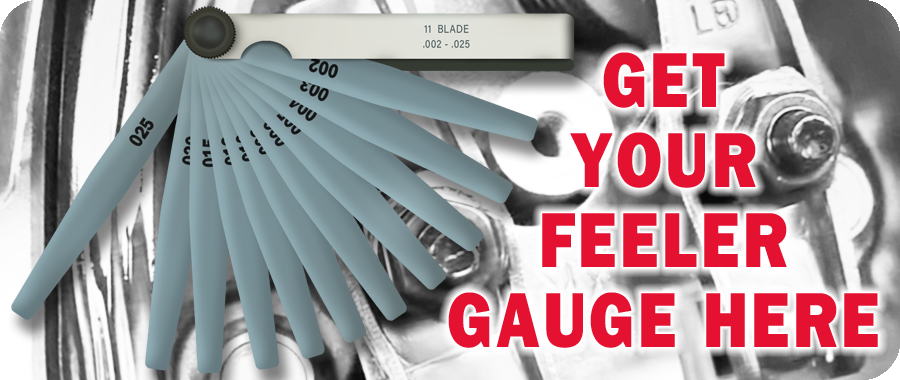
K) Once the rest of the engine has been fully rebuilt, set your Valve Lash Clearances to 0.015 inches OR 0.4 mm for both Intake and Exhaust. (If not running correctly, open the exhaust to 0.020 inches OR 0.5 mm).
You will need a Feeler Gauge to set your Valve Lash Clearances.
**Below is a great video that will guide you through setting the Valve Lash Clearances**
*Compatible part
We spend 1000's of hours every year providing Free Repair Advice. As you can imagine, this does not pay the bills! If you would like to buy us a coffee to say thanks, we would really appreciate it!


