
Oil Level Sensor, Internal Assembly GHG3520817

No reviews yet Write a Review
£39.99
£16.80
You save £23.19
Condition:
New
Stock Locations: USA, CAN, UK, EU, AUS. Worldwide shipping available. View full description
£39.99
£16.80
You save £23.19

Description

ghg-logo-large-hints-and-tips.png

Replacement Internal Oil Sensor

ghg-logo-large-sq-2023-roary-tm-med.jpg

Roary the Repair Lion says:

Testing:

Before replacing the internal oil level sensor, please check the Oil Alert Sensor CDI. If your engine is not starting, remove the wire (protrudes just above one of the oil fillers) from the oil sensor to the CDI, and try to start it again. If it starts you need to replace the external Oil Alert Sensor CDI (not the internal oil sensor). Do not run the engine without the Oil Alert Sensor CDI for any length of time, as it cannot shutdown the engine if there is a problem with the oil pressure, which could result in damage to the engine.

If you do need a new sensor, it may also be advisable to replace the Oil Alert Sensor CDI too. When Oil Sensors malfunction it often damages the CDI at the same time.

Rebuild Tips:

When replacing the Internal Oil Level Sensor Assembly it is advised to fit a new Gasket Kit to ensure the engine is sealed correctly.

A) Always oil all internal parts as you install them. Do not oil the gaskets or oil seals.

B) Fit the oil sensor. Be sure it is sitting in the groove correctly.

C) Install the governor and governor Arm shaft. Be sure the governor clip, and the split pin on the arm, has the flat side to the groove. Next install the arm washer on the arm shaft.

D) Connect the piston and the con rod. The "spike" on the con rod and the triangle on the head of the piston should be pointing in the same direction.

E) Install the piston with the triangle pointing down towards the push rods hole. (If new piston rings are being fitted, please see instructions on the piston ring page prior to fitting in the engine.)

F) Install the crankshaft and attach the con rod with "spike" pointing downwards. Torque: 14 N·m (1.4 kgf·m, 10.3 lbf·ft)

G) Install valve lifter tappets just before fitting the camshaft.

H) Install camshaft. Be sure to line up the punch marks on the crankshaft and the camshaft. If you do not do this the spark plug will not fire at the correct time and 99% of the time causes extensive damage to the internal working of the engine.

I) Using the new crankcase gaskets replace the side plate. Do not reuse old gasket! Torque: 24 N·m (2.3 kgf·m, 16.6 lbf·ft) 

J) Carefully insert oil seals. Do not oil the oil seal prior to installation.

K) Fit the flywheel. Torque: 128 N·m (13 kgf·m, 94 lbf·ft)

L) Replace oil drain bolt and refill oil. Torque: 22.5 N·m (1.8 kgf·m, 13 lbf·ft)

M) Once the engine has been fully rebuilt, set your Valve Lash Clearances to 0.015 inches OR 0.4 mm for both Intake and Exhaust. (If not running correctly, open the exhaust to 0.020 inches OR 0.5 mm).

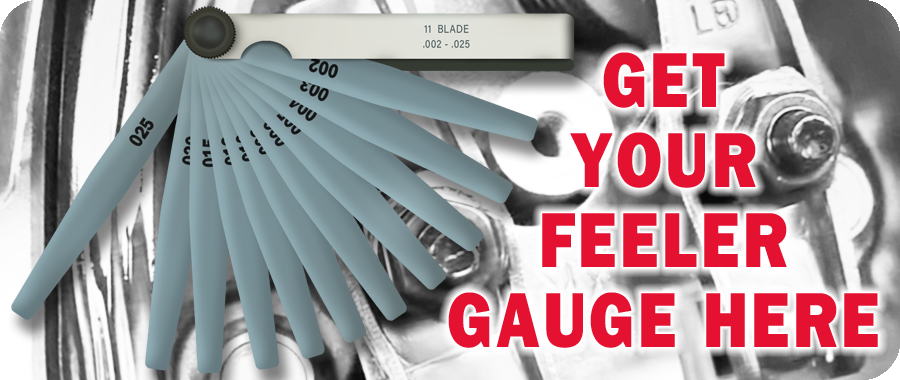
You will need a Feeler Gauge to set your Valve Lash Clearances. 

 feeler-gauge-900x380-oval-v2.jpg.png

**Below is a great video that will guide you through setting the Valve Lash Clearances**

*Compatible part 
 
We spend 1000's of hours every year providing Free Repair Advice. As you can imagine, this does not pay the bills!
If you would like to buy us a coffee to say thanks, we would really appreciate it!

Extra Information

Petrol Engine Machinery

Q. Why does my engine need the choke on to stay running?

A. Requiring the Choke to stay on to run is usually a fuel delivery problem and you should clean or replace the Air Filter and Carburetor. For further info on this, please Click Here:

Q. How do I fix a fuel leak from my Carburetor?

A. There are broadly two reasons for fuel leaking from the Carburetor. Either failed Seals or Gaskets. Or there is a Float Needle problem. We go into more if you Click Here:

Q. Why is my engine backfiring through the Carburetor?

A. On this type of engine, backfiring through the Carburetor is usually caused by problems in the Cylinder Head. Most commonly, the Valve Clearances need to be reset, or a Valve is stuck but this could also be other problems within the Cylinder Head so the parts need to be examined carefully. You can find a guide to resetting your Valve Clearances and more info, Click Here:

Q. I have no spark, what do I do?

A. There are initially three things to check, the low oil circuit, then the spark plug and ignition coil. For detailed instructions, Click Here:

Diesel Engine Machinery

Q. Why is my engine backfiring?

A. On this type of engine, backfiring is usually caused by problems in the Cylinder Head. Most commonly, the Valve Clearances need to be reset, or a Valve is stuck but this could also be other problems within the Cylinder Head so the parts need to be examined carefully. You can find a guide to resetting your Valve Clearances and further instructions, please Click Here:

Q. My starter motor is spinning but the engine will not fire?

A. These engines do not have a spark so this is often a fuel issue, for diagnostic steps, please Click Here:

Q. Why is my generator producing excess smoke?

A. This can depend on the colour of the smoke: black smoke is too much fuel/not enough air, so clean or replace the air filter then examine the injector; white smoke is usually water in the fuel, change the fuel and filters; blue smoke is a sign of burning oil, usually this is caused by failed valve seals or piston rings.

Electric Start Device

Q. Why does my generator battery keep going flat?

A. Generators recharge their own battery and the part that is responsible for this is called the Battery Charging Rectifier or Regulator and provides a steady voltage back to the battery while it is running, these parts are prone to overheating and failure, for please Click Here:

Q. Why doesn’t my electric start work?

A. Firstly, whether this is an engine problem or electric start problem needs to be established. If the generator starts with the pull start, please see the link below, it will describe the different electric start circumstances and what to do. Click Here: